



A Find Your Path gear guide.
People will happily spend three hundred dollars on shoes and then run in whatever socks came in a five-pack. Yet almost every blister, hot spot and black toenail we hear about at the fitting bench is a sock story as much as a shoe story. The right pair costs about as much as a café lunch and changes more runs than any gadget will.
Why blisters actually happen
A blister needs three ingredients: friction, moisture and repetition. Skin rubs against fabric (or other skin), sweat softens it, and a few thousand strides do the rest. Every good running sock is attacking one or more of those ingredients, moving moisture away from skin, cutting friction with smoother yarns and a closer fit, or removing skin-on-skin contact entirely.
The cotton problem
Cotton is comfortable in the shop and miserable at kilometre twenty: it drinks sweat, holds it against your skin, loses its shape and bunches. If you take one thing from this guide, retire cotton from running duty. Technical synthetics (like CoolMax) and merino wool both move moisture and hold their shape when wet.
Anatomical fit: left and right are different feet
Cheaper socks are knitted as tubes. Better ones are knitted anatomically, a dedicated left and right, with support zones mapped to the actual foot. Feetures builds its socks exactly this way, with targeted compression through the arch so nothing slips or bunches, and backs every pair with a lifetime guarantee. Once you've run in an anatomical sock, tube socks feel like borrowed gear.
Toesocks: the blister fix that looks odd and works
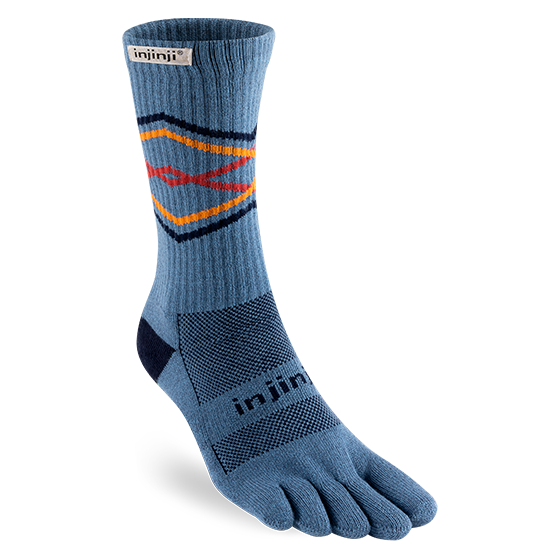
If your blisters happen between the toes, no conventional sock can fully help. The friction is skin on skin. Injinji wraps each toe individually so that contact never happens, which is why toesocks are near-standard equipment among ultrarunners and thru-hikers. They also let toes splay and work independently, which pairs naturally with anatomical, wide-toebox shoes. Give them one long run before you judge the look.
Merino or synthetic?
Synthetics dry fastest and tend to be the most durable per dollar. Merino regulates temperature beautifully (warm when it's cold, comfortable when it's warm), and resists odour on multi-day trips. Plenty of runners keep both: synthetics for fast, wet days; merino for winter, tramping and travel.
Weight and height
Weight is cushioning: lightweight for speed and a close shoe fit, midweight for daily miles, padded options for ultras and rough trails. Height is protection and preference: no-show for road, mini-crew or crew to keep trail grit out, over-the-calf where you want coverage or compression. Match height to terrain: crew heights earn their keep the first time you cross a scree slope.
When to replace them
Socks wear out invisibly: the cushioning packs down and the fibres stop moving moisture long before holes appear. If a pair has gone thin at the heel or slides where it used to grip, its work is done. A rotation of three or four good pairs, retired honestly, outperforms a drawer full of tired ones.
Get the size right
Sock sizes bracket shoe sizes, and the brackets differ by brand: check our sock size chart rather than guessing. Then browse men's and women's running and hiking socks, or start with the two brands above. They've earned their shelf space the hard way.


Leave a comment
This site is protected by hCaptcha and the hCaptcha Privacy Policy and Terms of Service apply.